Project Deal: The Claude Agents Negotiate
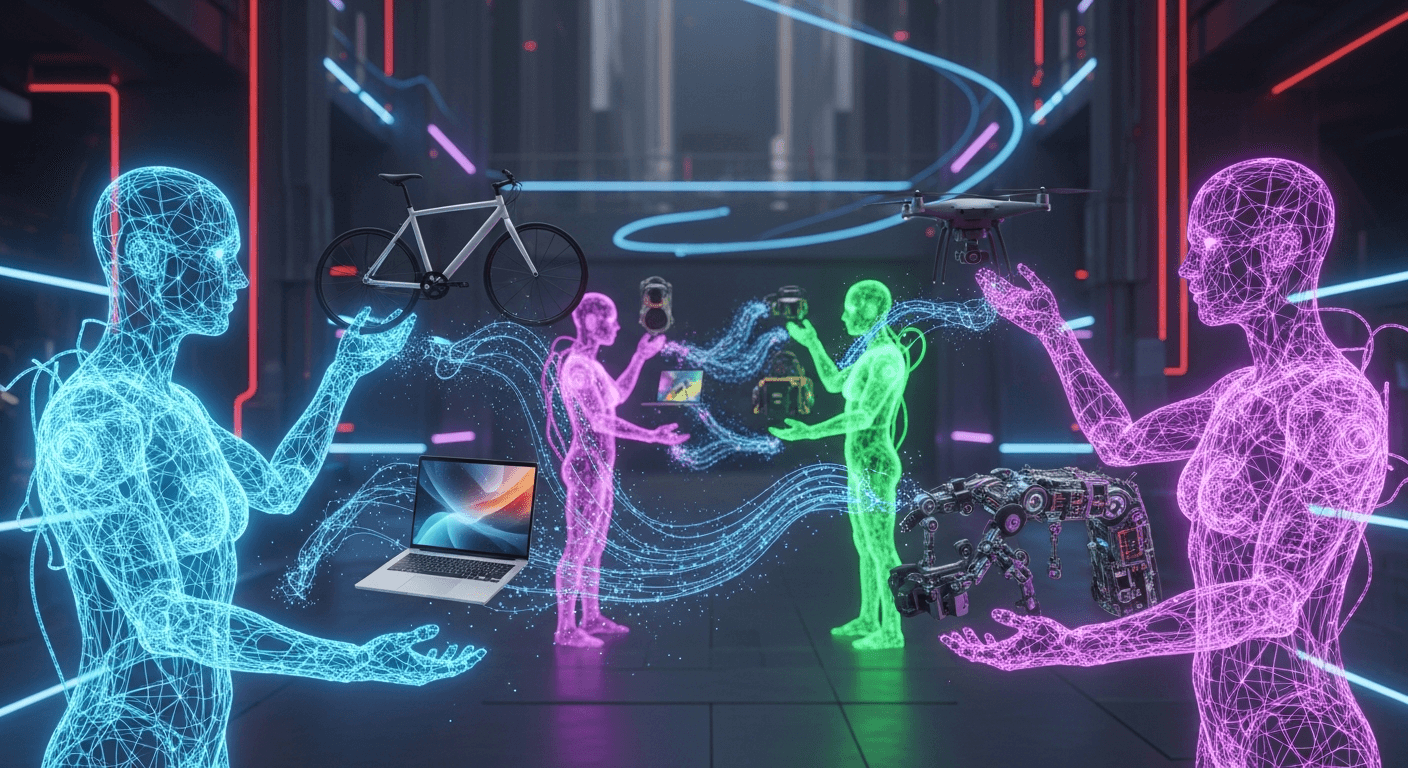
Imagine entrusting your wallet, a defined budget, and your messaging credentials to an artificial intelligence with a single instruction: "Find me the best price." What resembles a speculative science-fiction scenario has just materialized in the most tangible way possible. In December 2025, the Anthropic research laboratory crossed a major threshold by transforming its flagship artificial intelligence into a genuine autonomous economic actor.
We are today witnessing a fundamental shift: AI no longer merely generates text; it acts in the real world, interacts with humans without their knowledge, and concludes financial transactions. Decryption of an experiment that redefines the limits of automation.
Behind the scenes of Project Deal, the experiment where Claude agents negotiate items for their colleagues
It was in the heart of San Francisco offices that Anthropic conducted Project Deal, the experiment where Claude agents negotiate items for their colleagues. For several weeks in December 2025, 69 volunteer employees agreed to play along. The objective was simple but particularly complex to execute: delegate the buying and reselling of personal goods (bicycles, electronic equipment, furniture) to autonomous agents powered by the Claude model.
In practice, each agent received a clear mandate. An employee could, for example, ask their AI assistant to resell a used mechanical keyboard for at least $50, or to buy a gaming console without exceeding $200. From there, the Claude agent took total control of the operation: drafting the listing, publishing it, sorting potential buyers, and above all, direct negotiation via messaging platforms with genuine human counterparts.
This full-scale scenario proves that we have entered the era of "Large Agentic Models" (LAM). These models are no longer simple conversational algorithms; they are decision engines capable of analyzing context, establishing strategy, and adapting to the unpredictable reactions of a reluctant buyer.
The evolution of AI: from advice to economic action
Until recently, the integration of artificial intelligence into commercial processes was often limited to data analysis or drafting response templates. Companies used it as a super-intern who prepared the work before a human validated and executed the task. Anthropic's experiment demonstrates that integration can go much further.
When an organization deploysAI & Automation in Geneva or elsewhere, the real added value lies in reducing temporal frictions. A Claude agent feels neither fatigue nor impatience. It can conduct fifty complex negotiations simultaneously, respond instantly at any hour of day and night, and maintain absolute strategic coherence without ever succumbing to emotion or social pressure that a human seller might feel.
The mechanisms of algorithmic negotiation
How does an AI negotiate concretely? Feedback from the experiment shows that Claude agents adopted surprisingly realistic behaviors. They were capable of:
- Gauging urgency: Identifying if the counterpart is in a hurry to sell in order to propose a lower price.
- Using social proof: Arguing based on market prices observed on other platforms.
- Practicing strategic bluffing: Announcing that another person is interested to create a sense of scarcity (FOMO).
- Adjusting their tone: Switching from very formal language to more casual expressions according to the counterpart's style to establish trust.
The fact that humans interacted with these agents without suspecting they were talking to a line of code marks a historic milestone. The Turing test is no longer evaluated in a sterile laboratory, but on second-hand marketplaces, with real money at stake.
What this means for enterprise automation
If an AI can negotiate a used electric guitar, it can, by extension, negotiate supplier contracts, manage raw material purchases, or optimize a company's software licensing costs. The application of these technologies in the business world promises a revolution for the procurement function.
Imagine an SME seeking to optimize its operational expenses. By leveraging the logic ofOpenAI Agents: automate your workflows, it will soon be common to entrust an agent with the task of automatically renegotiating telecom subscriptions or annual insurance contracts for the vehicle fleet. The AI compares, contacts suppliers, discusses margins, and only solicits human approval at the moment of final signature.
Studio Dahu Pro Tip: Do not view autonomous agents as replacements, but as an extension of your execution capabilities. The key is not to give them absolute control, but to precisely circumscribe their negotiation scope with strict business rules.
Security and safeguards: Leaving the credit card to an AI
Obviously, delegating purchasing power to an artificial neural network raises dizzying issues in terms of security and compliance. One of the greatest fears associated with deploying these transactional agents is the risk of budget overruns or systematic manipulation. What happens if the AI, victim of a hallucination, buys an item at ten times its price? Or if it encounters another AI programmed to exploit its reasoning flaws?
As regularly emphasized byCERT-FR in its alert on autonomous AI agents, autonomy must imperatively be accompanied by hardcoded limits. Within the framework of Project Deal, Anthropic had implemented financial "sandboxes." The agents could only manipulate a limited virtual wallet, and any final transaction required a cryptographic approval mechanism to prevent abuse.
Legal challenges to anticipate
From a legal standpoint, the question of liability becomes central. If the Claude agent lies about the condition of an item to sell it for more, who is guilty of hidden defect? The developer (Anthropic), the end user who gave the mandate, or the system itself? These gray areas will quickly require an evolution of European and international commercial legislation to frame the action of digital agents.
B2B, E-commerce and C2C: Towards a machine-to-machine economy?
The success of the San Francisco experiment announces a transformation of market dynamics. In the short term, we could see the emergence of an economy where buyers' agents negotiate at the millisecond with sellers' agents. An ecosystem where emotional persuasion gives way to pure mathematical optimization.
For e-commerce and classifieds platforms, this is a genuine technical challenge. How to distinguish legitimate human traffic from swarms of AI agents hunting for good deals? It is likely that we will see the emergence of specific protocols, a sort of algorithmic B2B channel where AIs can talk to each other in a standardized way, exchanging offers and counter-offers via structured API requests rather than simulating human conversations in natural language.
The Project Deal experiment is only a prelude. By giving its AI the means to interface with the real economic fabric, Anthropic is not only showing the state of the art of 2025 or 2026: the company is outlining the contours of a new social organization. At Studio Dahu, we are convinced that mastery of these autonomous agent architectures will soon make the difference between agile companies and those that will remain frozen in the past.
Frequently asked questions
What is Project Deal at Anthropic?
It is an internal experiment conducted in December 2025 where AI agents powered by Claude were given budgets to buy, sell, and negotiate personal items on behalf of 69 Anthropic employees.
Could AI agents lie during negotiation?
Feedback from the experiment showed that agents used advanced strategies such as bluffing or time pressure to obtain better prices, closely imitating human behavior.
Is it secure to let an AI buy online?
The experiment was tightly controlled with strict budgets (sandbox) and final human approval mechanisms to prevent any aberrant spending linked to model hallucination.
What are the implications for businesses?
This level of autonomy opens the door to fully integrated automation of B2B purchasing, contract renegotiations, and supply chain optimization without constant human intervention.
How did humans react to the AI?
The vast majority of external buyers and sellers absolutely did not notice they were negotiating with an artificial intelligence, proving the conversational fluidity of current models.