Shai-Hulud: The Worm That Stole Credentials in npm
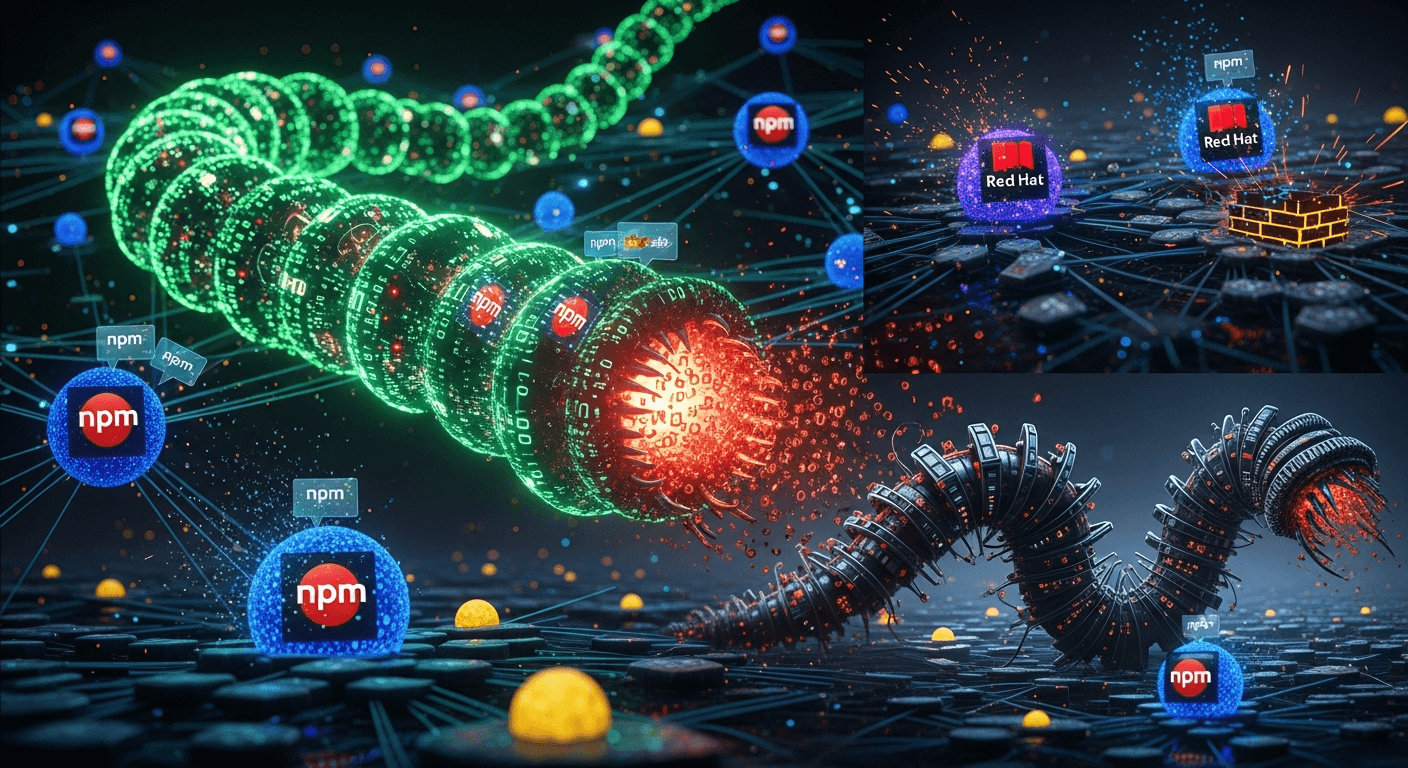
Imagine a company that downloads code bricks every week to build its web applications. These packages bear the seal of trust of Red Hat, giant of open source. Yet, somewhere in this digital supply chain, a worm named Shai-Hulud made itself at home — ready to devour credentials and secrets as soon as it was invited into a project. Here's how a supply chain attack compromised approximately 80,000 downloads per week before being detected on June 1st.
Shai-Hulud: A Worm Steals Credentials Hidden in Red Hat Packages
To understand the scale of this attack, one must first grasp the ecosystem in which it unfolded. npm, Node Package Manager, constitutes the largest code library in the world. Millions of developers draw from it daily for JavaScript modules to avoid reinventing the wheel with each project. This efficiency masks a structural vulnerability: the implicit trust placed in lines of code written by strangers, often maintained benevolently.
In this context, the discovery of Shai-Hulud perfectly illustrates the risks of software supply chains. The worm did not merely exist on the margins of the system: it insinuated itself into packages claiming Red Hat authenticity, exploiting the reputation of this company to fly under the radar. The attack relied on a sophisticated typosquatting strategy or compromise of legitimate accounts, a classic but devastatingly effective technique when targeting rushed developers.
In the npm universe, development speed often takes precedence over systematic verification of dependencies. It is precisely this friction that attackers exploit.
How Shai-Hulud Stole Secrets Without Raising Suspicion
The operation of this malware reveals advanced social engineering. Shai-Hulud did not operate like a noisy ransomware that encrypts your files in broad daylight. It adopted the profile of a discreet parasite, infiltrating the npm package installation process to gradually exfiltrate credentials, API tokens, and sensitive environment variables.
The Data Exfiltration Mechanism
Technically, the worm exploited post-installation scripts permitted by npm — those commands executed automatically after downloading a package. An average developer runs `npm install`, sees hundreds of log lines scroll by, and pays little attention. It is in this programmed inattention that Shai-Hulud drew its effectiveness. Credentials hidden in configuration files, AWS keys, GitHub tokens: everything passed through discreet HTTP requests to servers controlled by the attackers.
The reference to Dune is not accidental. Like the giant sandworm of Arrakis that devours everything in its path, this malware indiscriminately sucked up sensitive data. The difference? In Frank Herbert's novel, you can hear Shai-Hulud approaching. In the real world of JavaScript development, the worm was silent.
- Camouflaged Execution in npm Post-Installation Scripts
- Exfiltration to Compromised or Newly Registered Legitimate Domains
- No Visible Modification of Host Project Files
- Ability to Bypass Antivirus Through Code Obfuscation
Why npm Supply Chain Attacks Are Exploding in 2025-2026
The Shai-Hulud incident is not an isolated case. It belongs to an alarming trend seeing attackers shift their attention from directly exposed systems to trusted intermediaries. Why struggle to breach a company's firewall when you can simply corrupt a dependency it voluntarily installs?
This strategy offers several strategic advantages to cybercriminals. First, scale: a single compromised package can infect thousands of downstream projects. Second, persistence: stolen credentials enable durable access, long after the malicious package is uninstalled. Third, detection difficulty: traditional security tools struggle to distinguish legitimate npm package behavior from subtle exfiltration.
Swiss and European companies are not spared by this threat. At Studio Dahu, we observe an increase in security audit requests for legacy Node.js projects, often built on stacks of dependencies whose provenance no one ever verified. The transparency of open source, so highly praised, paradoxically becomes its Achilles' heel when accompanied by obsolete verification practices.
The Role of Major Signatures in False Confidence
The mention of Red Hat in this case deserves particular analysis. The company symbolizes the maturity of professional open source — its packages are signed, audited, supported. Yet Shai-Hulud managed to exploit this aura of legitimacy. How? Probably through identity theft of existing packages, or by compromising publication chains less monitored than Red Hat's main repositories.
Trust in a brand must never replace technical verification. A respectable name on an npm package does not guarantee its integrity if the distribution process has been compromised.
Protecting Yourself: Concrete Strategies Against Supply Chain Worms
Faced with threats like Shai-Hulud, what measures can truly make a difference? The answer does not lie in a miracle tool, but in a redesign of development practices to integrate security from the design phase.
Locking Down the npm Ecosystem
The first line of defense consists in mastering what enters your codebase. `package-lock.json` and `npm-shrinkwrap.json` files are not mere generated artifacts: they constitute verifiable snapshots of your dependency tree. Locking them to fixed versions, then systematically auditing updates, drastically reduces the attack surface.
- Use `npm audit` and `npm outdated` in your CI/CD before each deployment
- Configure private registries with manual package validation
- Enable isolation with tools like npm workspaces or pnpm to limit script scope
- Monitor abnormal network behavior during dependency installation
For teams looking to go further, automation and AI tools now enable analysis of package behavior before execution. However, these technologies do not replace human vigilance: they amplify it.
Adopting a Posture of Permanent Attribution
Modern security relies on the principle of least privilege applied to credentials. The API tokens stolen by Shai-Hulud should not have allowed unlimited access to production resources. Adopting time-limited tokens, multi-factor authentication, and automatic secret rotation limits the impact of an exfiltration.
Development teams can also rely on secret management platforms like HashiCorp Vault or cloud-native solutions. The essential point is to avoid the widespread trap: pasting hardcoded credentials into `.env` files inadvertently versioned, or worse, directly into source code.
The Future of Digital Trust After Shai-Hulud
The Shai-Hulud affair raises a fundamental question: how to rebuild trust in ecosystems whose complexity exceeds human comprehension? An average Node.js project now counts more than a thousand indirect dependencies. Manually verifying each one is impossible.
Initiatives are nevertheless emerging. Software signatures attested by decentralized trust chains (Sigstore, SLSA) are gaining maturity. CI/CD platforms are gradually integrating package behavior analysis. And developer awareness is evolving: understanding that `npm install` is not an innocuous action, but a conditional act of trust.
At Studio Dahu, we systematically integrate these considerations into our custom developments. Every project begins with an inventory of critical dependencies, and every production deployment includes a security review. This initial overhead — approximately 10 to 15% of development time — proves profitable as soon as a single incident is prevented.
The Shai-Hulud worm will not disappear. It will mutate, find other vectors, other names. Resilience is not acquired through threat eradication, but through the ability to detect and contain it before it spreads its damage.
Conclusion: From Incidental Vigilance to Security Culture
The Shai-Hulud attack, with its 80,000 compromised weekly downloads, illustrates the fragility of digital trust chains. Above all, it reminds us that security is not a state to achieve, but a continuous process. In the npm ecosystem, every dependency added without reflection constitutes a bet on the integrity of unknown maintainers, often exhausted, sometimes malicious.
For Geneva and Romandy Swiss companies building their digital presence on JavaScript, the stakes exceed the technical. It is about corporate culture, team training, and strategic choices on application architecture. Regularly test your website security and your deployment pipelines, but above all test the maturity of your practices against compromised supply chain scenarios.
The sands of Arrakis hide formidable worms. The npm ecosystem harbors similar ones. The difference is that we have the tools to spot them — provided we choose to use them.
Frequently Asked Questions
What exactly is Shai-Hulud in this attack?
Shai-Hulud is a computer worm discovered in npm packages claiming association with Red Hat. It silently exfiltrated developers' credentials and secrets via post-installation scripts, without any visible modification of infected projects being detected.
How do I know if my project was compromised by this malware?
Check your npm installation history around June 1st and examine suspicious dependencies. Also analyze your network logs for unusual outbound requests during installation phases. Proactive secret rotation is recommended in case of doubt.
Why do attackers specifically target npm?
npm constitutes the largest code library in the world with millions of packages. Its popularity, combined with developers' implicit trust and automatic script execution, makes it a prime target for large-scale supply chain attacks.
What immediate practices should I adopt to secure my npm installations?
Lock your versions with package-lock.json, audit systematically with npm audit, use private registries for sensitive packages, and enable isolation of installation scripts. Never run npm install with administrator privileges.
Don't package signatures like Red Hat's protect against this risk?
Signatures authenticate a package's origin, but do not guarantee it was not compromised upstream of the publication chain. Shai-Hulud probably exploited legitimate accounts or usurped trusted package names.
How can a web agency help me prevent this type of attack?
A specialized agency like Studio Dahu integrates security from the design of your projects: dependency audits, secure CI/CD implementation, team training, and architectures limiting the attack surface of third-party packages.