Custom SME Dashboard Development: 2026 Guide
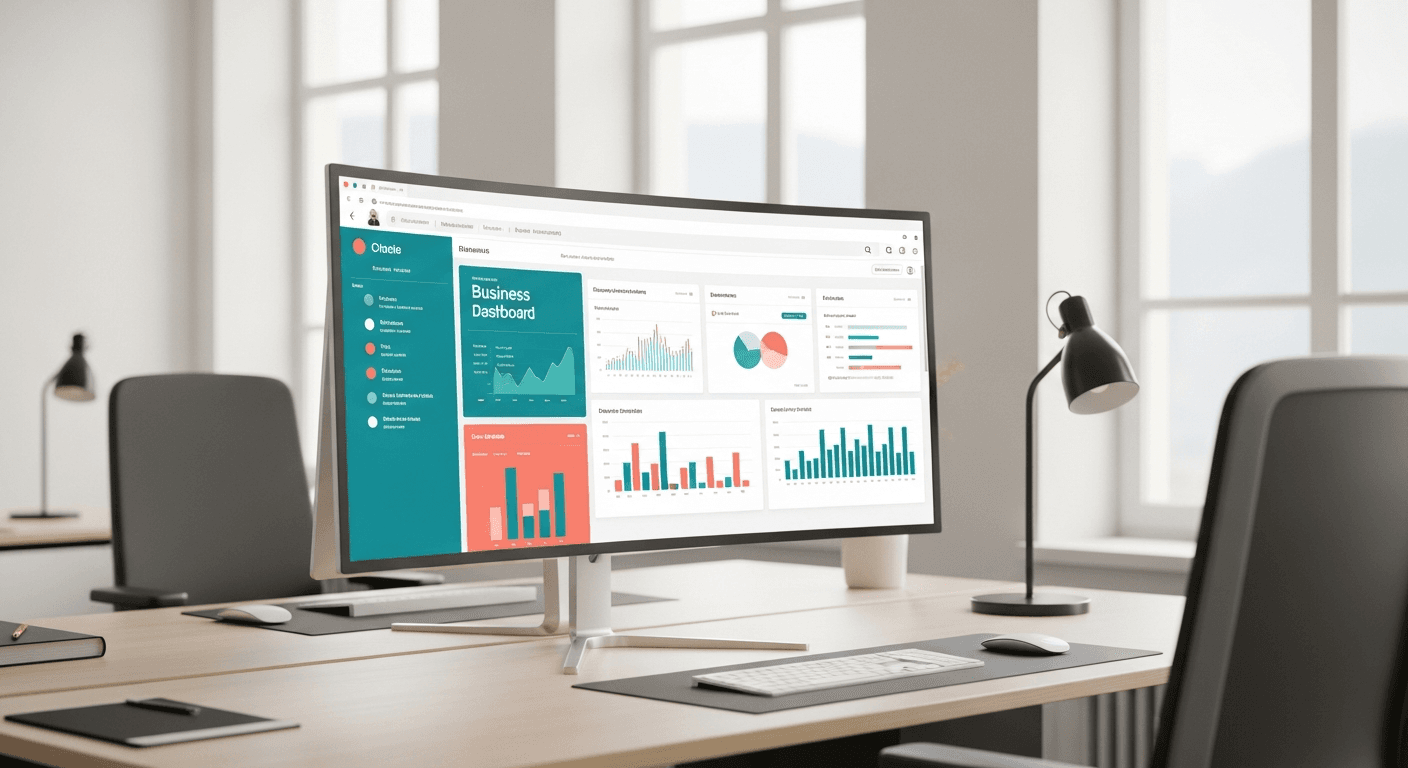
Imagine running your SME while flying blind. Every decision based on intuition, every monthly report already obsolete before being read. This is the daily reality for thousands of Swiss companies that still depend on fragmented Excel spreadsheets and pivot tables forgotten in shared folders. Custom SME dashboard development represents precisely the breakthrough these organizations have been waiting for: a living management tool, designed for their specific needs, capable of transforming raw data into strategic leverage. At Studio Dahu, we observe every day the growing gap between companies equipped with an adapted dashboard and those struggling to identify their own performance indicators. This article demonstrates why custom solutions stand out as the most profitable investment for ambitious SMEs.
Why Generic Dashboards Fail with SMEs
Off-the-shelf solutions promise the world: integration in 48 hours, attractive pricing, proven templates. Yet, after six months of use, nearly 60% of SMEs abandon these platforms. The reason? A structural mismatch between what the tool offers and what the company actually experiences.
The Tyranny of Standardized Templates
A Geneva law firm and a Vaud construction company do not share the same data flows, decision rhythms, or end users. Yet, Power BI or Tableau lock them into identical grids. The template standardizes display at the expense of business logic. Result: teams create workarounds outside the dashboard, reintroducing the very inefficiency the tool was meant to eliminate. It is precisely in this gap that custom SME dashboard development positions itself: it starts from your existing processes to amplify them, rather than imposing a foreign architecture.
The Hidden Cost of Permanent Adaptation
Generic software vendors charge heavily for every customization. An extra chart? A connector to your in-house ERP? Development fees accumulate, making the total cost comparable — sometimes higher — than a solution custom-built from the start. Our projects systematically demonstrate that an architecture designed for the SME generates economies of scale from the second year of operation.
Pro tip: Evaluate TCO (total cost of ownership) over 3 years, not on the first quote. Custom solutions often win at this game.
The 5 Pillars of a High-Performance Custom Dashboard
A successful dashboard is not limited to beautiful charts. It is built around five dimensions that every SME must master before even launching its project.
1. Upstream Data Reliability
The most beautiful screen is only worth the quality of what it displays. SMEs willingly underestimate this phase: multiple unsynchronized sources, duplicates in the customer database, fields left empty out of habit. Custom SME dashboard development integrates a data audit and automatic validation rules from the design stage. Imagine an industrial SME whose production data comes from IoT sensors, sales data from a Salesforce CRM, and accounting from Swiss software like Bexio. Without rigorous orchestration, the dashboard will display inconsistencies that end users will eventually stop believing — and then stop consulting.
2. Relevance of Selected KPIs
The classic mistake is wanting to measure everything. An effective dashboard selects 5 to 8 truly actionable indicators for each user profile. The CEO will monitor cash flow and customer acquisition; the operations manager, cycle times and rejection rates. This role-based segmentation, impossible in generic solutions without heavy configuration, is a natural strength of custom development.
- Identify who decides what, at what frequency
- Trace the causal chain between action and result
- Eliminate indicators that are "nice to have" but not actionable
- Plan personalized alert thresholds by profile
3. Speed of Access and Refresh
A field sales rep checks their smartphone between two meetings. A CFO analyzes trends on a 27-inch screen Friday morning. The same dashboard must serve both contexts without degrading the experience. Modern architectures — Next.js for front-end, REST or GraphQL API for data — enable this versatility. At Studio Dahu, we prioritize technical stacks guaranteeing loading times under 2 seconds, even on hesitant mobile connections.
4. Security and Compliance
The GDPR and the Swiss FADP revision impose strict constraints on the collection and exposure of personal data. A poorly configured dashboard can transform a simple sales performance display into a customer data leak. Custom development allows native integration of encryption, pseudonymization, and granular consultation roles — all layers that SaaS solutions charge as additional modules.
5. Scalability Designed from the Start
A growing SME changes structure, markets, and software. The dashboard must accompany this transformation without complete reconstruction. Modular architecture, standardized connectors, and internal technical documentation guarantee this temporal resilience.
How to Structure Your Custom SME Dashboard Development Project
Moving from intention to execution requires a proven methodology. Here is the framework we systematically apply to avoid budget and schedule overruns.
Immersion Phase: Map the Existing State Without Judgment
Before any line of code, our teams spend 2 to 5 days on-site (or in in-depth video conferences) to understand how data actually flows — not officially. Who enters what? Where? With what error frequency? These observations often reveal critical informal processes, never documented, that the dashboard must preserve or formalize. This step, neglected by turnkey solution integrators, determines 70% of final satisfaction.
Co-Design Phase: Prototype Fast, Iterate Early
We develop interactive wireframes within 48 hours, tested with future users before any development. This early validation eliminates costly misunderstandings. A marketing manager discovering at delivery that "their" indicator was not the one the developer had in mind represents a correction cost multiplied by 10. Rapid prototyping, facilitated by tools like Figma and modern frameworks, drastically reduces this risk.
Development Phase: Controlled Agility
We organize work in two-week sprints, with functional demonstrations at each iteration. The SME thus maintains control of its priorities and can reorient the project if a business opportunity emerges mid-course. This flexibility, impossible in the rigid fixed-price contracts of major vendors, characterizes the custom development approach we advocate.
Golden rule: A dashboard delivered without user training and without customized technical documentation is a dashboard doomed to abandonment within 12 months.
Budget and ROI: Demystifying Custom Development Numbers
The most frequent objection to custom SME dashboard development concerns initial cost. Yet, SMEs that take the leap report measurable return on investment in 8 to 14 months. Understanding this dynamic enables serene decision-making.
The Real Cost of Lack of Real-Time Management
An SME of 25 employees spending 6 hours weekly on manual data consolidation multiplies this load by 52 weeks, or 312 hours annually. At an average loaded rate of 80 CHF, this represents 24,960 CHF in wasted productivity — not counting delayed decisions, missed opportunities, and oversized inventory. A custom dashboard, amortized over 3 years, typically costs between 35,000 and 80,000 CHF depending on complexity. The economic equation thus naturally balances, especially since the tool generates structural gains beyond mere elimination of manual tasks.
Intangible Value Levers
Beyond the accounting calculation, a well-designed dashboard transforms company culture. Teams have visibility into their contribution to overall results. Managers stop managing by impression and start steering by facts. Weekly meetings gain conciseness and effective decisions. These benefits, difficult to quantify a priori, often constitute what leaders appreciate most in the medium term.
Technologies and Architecture: The Choices That Make the Difference
A dashboard's technical stack conditions its performance, maintainability, and evolutionary cost. Here are the directions we recommend in 2026 for Swiss SMEs.
Front-End: React and Its Derivatives for Interactivity
React, and particularly Next.js in its recent version, offers the best compromise between interaction richness and performance. Visualization components (Recharts, Victory, or more specialized solutions like Tremor) enable adaptive rendering without heavy overlay. For SMEs with very specific business needs, complementary mobile application development extends the dashboard's reach beyond the office.
Back-End and Database: Pragmatism Before Hype
PostgreSQL remains the reference for most use cases, complemented by extensions like TimescaleDB for time series. When data volume justifies a more distributed architecture, we carefully evaluate the complexity cost induced. An SME does not have the same constraints as Netflix; its infrastructure must reflect this reality. Hosting in Switzerland also guarantees compliance with data sovereignty requirements.
Artificial Intelligence as Accelerator, Not Replacement
Generative AI models are now transforming the dashboard experience: natural language querying, predictive anomaly detection, automatic narrative report generation. But these capabilities integrate relevantly only on solid data foundations. Attempting AI on disorganized data amplifies errors rather than correcting them. Our automation and AI teams therefore intervene in a second phase, when data maturity justifies it.
Conclusion: The Dashboard as Transformation Catalyst
Custom SME dashboard development is not a technology expense. It is a strategic investment that reveals a company's ability to learn from its own data and act faster than its competitors. In an economic environment where agility trumps size, SMEs equipped with an adapted management tool have a determining structural advantage.
The question is no longer whether your SME can afford a custom dashboard. It is how much longer it can do without one without irretriably losing ground.
Frequently Asked Questions
What is the average timeline to develop a custom dashboard for an SME?
Depending on complexity, expect 6 to 12 weeks for a first operational deployment. The immersion and prototyping phases represent one-third of this timeline, but drastically reduce acceptance risks.
Do we need perfectly clean data before starting?
No, and this is a blocking myth. A custom dashboard project specifically integrates a cleaning and structuring phase. The important thing is to identify sources and their respective qualities from the start.
Can a dashboard be connected to any existing software?
In the vast majority of cases, yes. Modern APIs, standard connectors (REST, GraphQL, ODBC), and file parsing enable integration of heterogeneous systems, including old or uncommon business software.
How to train teams on the new dashboard?
Training is integrated into our deliverables. We recommend short sessions (2 hours) per user profile, complemented by customized visual documentation. Adoption progresses significantly when an internal referent is designated.
What maintenance does a custom dashboard require?
Evolutionary maintenance (corrective and adaptive) is recommended. Budget approximately 15-20% of initial cost annually. It covers security updates, adaptation to changes in your data sources, and addition of new features.
Is a custom dashboard accessible on mobile?
Yes, natively if the architecture provides for it from design. Responsive interfaces, or even dedicated mobile applications for field profiles, now constitute a standard requirement in our developments.