Next.js vs WordPress Maintenance: The Geneva Guide
Is your website an asset that works for you, or a financial liability slowing down your growth? In Geneva, the digital presence market is saturated with "turnkey" solutions that, after a few months, turn into nests of technical problems. The question of website maintenance in Geneva should not be limited to whether your plugins are up to date, but rather to understanding the viability of your infrastructure over five or ten years. Between the historic giant WordPress and the modern outsider Next.js, the duel is not just technical; it is strategic. In an ecosystem where performance and security are the pillars of conversion, choosing your tech stack is equivalent to choosing the level of technical debt you are willing to assume.
Comparative Table: WordPress vs Next.js Maintenance
- Security: WordPress requires weekly patches; Next.js is secure by design (decoupled architecture).
- Performance: WordPress degrades with the accumulation of plugins; Next.js offers constant and optimal speed.
- Updates: WordPress risks compatibility issues; Next.js uses controlled and isolated dependencies.
- Long-term cost: WordPress is cheaper initially but expensive in corrective maintenance; Next.js requires an initial investment but offers exemplary stability.
- Flexibility: WordPress is limited by its templates; Next.js allows for total custom development without constraints.
WordPress: The Reality of Website Maintenance in Geneva in Legacy Mode
WordPress has dominated the web for two decades. Its strength lies in its accessibility. However, this ease of use hides a technical complexity that becomes a burden during the maintenance phase. Imagine a Geneva-based company that launches its site on WordPress to save on initial development. After two years, it ends up with 40 plugins installed, each with its own update cycles and vulnerabilities. Website technical support then becomes a race against time to avoid the dreaded "white screen of death" with every system update.
Maintenance on WordPress is essentially corrective. You fix what breaks. You install security patches because a critical flaw was discovered in a form or photo gallery plugin. In Geneva, where quality standards are high, experiencing a service interruption because an obsolete plugin crashed the database is unacceptable. This is one of the traps of the traditional web: believing that a site that is free to maintain is never really free.
Our assessment: On WordPress, the further you go in time, the more the cost of a simple modification increases exponentially due to the stacking of unstable dependencies.
Next.js: The Modern Approach to Application Maintenance
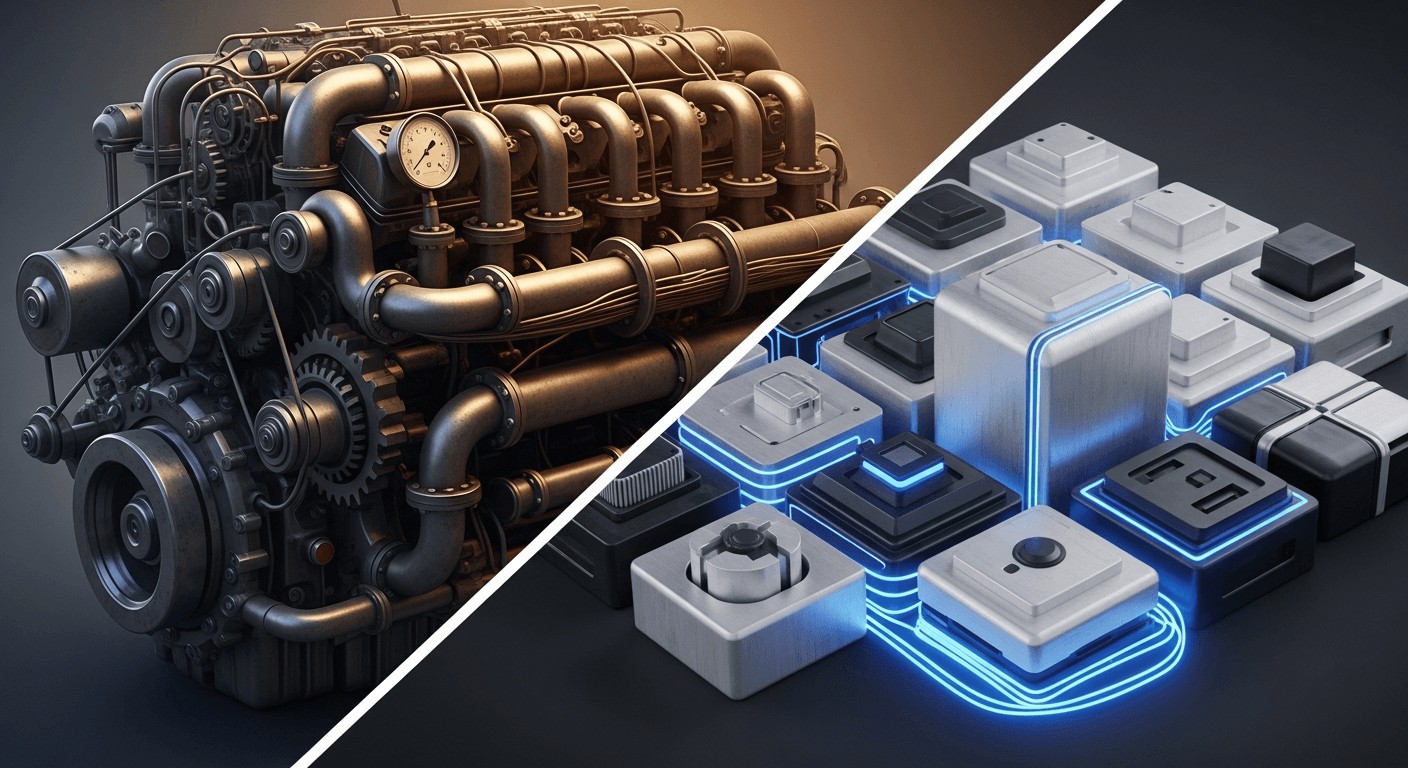
In contrast to WordPress, Next.js represents the era of the modern, high-performance web. Unlike a monolithic CMS where the design, database, and administration are intertwined, Next.js separates responsibilities. By using a "Headless" CMS like Payload, you benefit from a structure where maintenance no longer involves plugging holes, but evolving features. This is what we explain in our article on the 10 reasons to leave WordPress for Next.js.
Maintenance of a Next.js stack is predictive and scalable. Since the code is custom-written, there is no "dead" or useless code slowing down the server. Imagine a service platform in Geneva that manages significant data flows: with Next.js, security updates are almost non-existent at the frontend level because there is no directly exposed database. The time saved for the technical team is massive, as they focus on improving the user experience rather than system survival.
Hidden Costs and Technical Debt: The 5-Year Duel
The cost of website maintenance in Geneva must be analyzed over the entire project lifecycle. A classic mistake is to compare only the initial quote. WordPress seems unbeatable here. But let's analyze the next five years. On WordPress, you will pay a monthly fee for backups, plugin updates, database cleanup, and emergency interventions. Furthermore, every 3 or 4 years, a complete redesign is often necessary because the theme has become obsolete or incompatible with new PHP versions.
With Next.js, the initial investment is more substantial because it requires sharper software engineering expertise. However, the stability is such that a site can remain high-performing and secure for 5 years without major intervention. The Total Cost of Ownership (TCO) shifts in favor of custom development by the third year. For a Swiss SME, choosing a modern WordPress alternative is not a luxury; it is a rational accounting decision to avoid recurring unforeseen costs.
The Impact on SEO and Conversion
Maintenance is not just about code; it is also about visibility. A poorly maintained WordPress site slows down. A slow site loses positions on Google. Conversely, maintaining a Next.js site includes native optimization of Core Web Vitals. As part of a SEO in Geneva strategy, having an architecture that does not require complex caching plugins to be fast is a major competitive advantage.
Criteria for Choice: Which Solution for Your Geneva-Based Company?
The choice between these two approaches depends on your business goals and your ability to invest in quality. If you are a freelancer launching a personal blog with a minimal budget, WordPress remains a valid option, provided you drastically limit the use of third-party plugins.
However, you should seriously consider Next.js if:
- Your website is your primary acquisition or sales channel.
- You handle sensitive data from Swiss customers and security is non-negotiable.
- You plan to scale your site with specific business features.
- Loading speed is critical to your conversion rate.
- You want to free yourself from technical dependence on theme editors.
Expert advice: Do not ask 'How much does the site cost?', but 'How much will each hour of downtime or each security breach cost me in 2 years?'.
Verdict: Why Custom Development Wins in the Long Run
As a web agency in Geneva specialized in cutting-edge technologies, our verdict is clear: for any serious project, application maintenance on Next.js offers peace of mind that WordPress can no longer guarantee today. Maintenance should no longer be seen as a repair chore, but as a continuous improvement process.
Switching from a legacy stack to a modern architecture means transforming a suffered fixed expense into an agile investment. At Studio Dahu, we support companies in this transition so that their digital tool becomes a growth engine again: fluid, fast, and above all, sustainable. The rational choice for your website maintenance in Geneva is found in the simplicity of the code and the power of the architecture.
Frequently Asked Questions
What is the average maintenance cost for a WordPress site in Geneva?
For a professional site, count between 150 and 400 CHF per month for serious maintenance including updates, backups, and security, excluding corrective interventions in case of a major bug.
Is it difficult to migrate from WordPress to Next.js?
It is a structural redesign. The content can be migrated, but the code must be rewritten. This is the ideal time to radically optimize your performance and SEO.
Is Next.js really more secure?
Yes, because it is often a static or hybrid site without an administration interface exposed directly to hackers, unlike WordPress, whose plugin vulnerabilities are the #1 target on the web.