Custom Development vs CMS: The Performance Comparison
Is your website a growth engine or a technical burden hindering your expansion? In a Romande digital ecosystem often saturated with pre-built solutions and marketing agencies with rigid methods, technical architecture has become the central pivot of commercial success. The truth is brutal: an additional second of loading time can reduce conversions by 20%. This observation presents decision-makers with a strategic dilemma: should they continue to rely on traditional CMS like WordPress or take the leap towards custom development?
The Illusion of Digital Ready-to-Wear: The Limits of Traditional CMS
Traditional Content Management Systems (CMS) have long dominated the web with their promise of simplicity. However, for a Geneva-based company aiming for excellence, this apparent simplicity hides heavy technical debt. The monolithic model, where design, database, and code are tightly linked, creates unavoidable bottlenecks. Every plugin added to fill a functional gap bloats the source code, multiplies HTTP requests, and opens potential security breaches.
The Weight of Technical Obsolescence
In a classic CMS configuration, the server must generate the page for every visit by querying an often poorly optimized database. This process, while functional for low-traffic sites, becomes a major handicap as soon as one seeks to scale. Generalist agencies often settle for stacking layers of cache to hide these slowdowns, but the underlying problem remains: the architecture itself is not designed for high performance.
The true cost of a 'free' or low-cost CMS reveals itself in maintenance, incessant security patches, and lost opportunities linked to degraded SEO.
Custom Development vs CMS: The Performance Comparison via Data
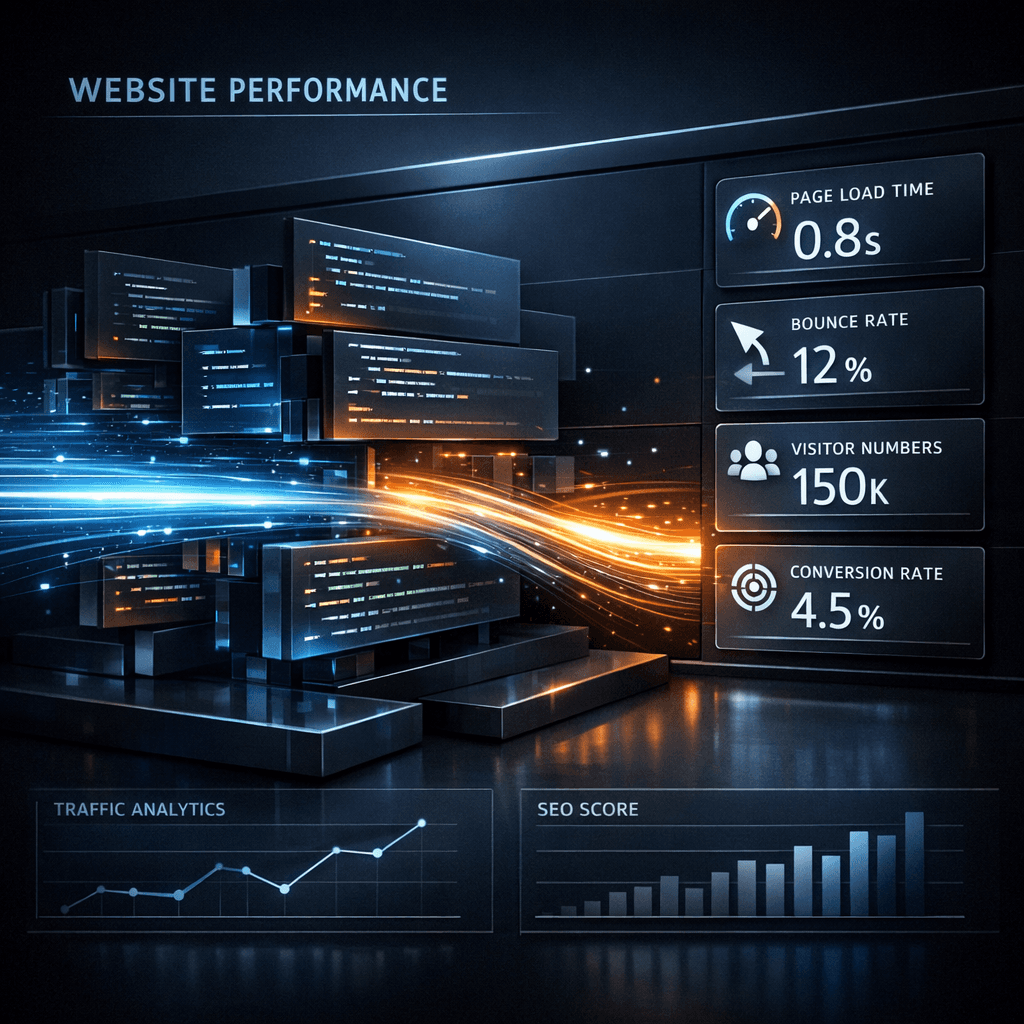
To understand the superiority of custom development, one must analyze Core Web Vitals, the Google performance indicators that now dictate your positioning. When pitting custom development in Geneva against packaged solutions, the numbers speak for themselves. A custom site designed with a Headless (decoupled) architecture generally displays performance scores 3 to 4 times higher than a standard WordPress site.
- Largest Contentful Paint (LCP): On a custom site, main content often appears in less than 1.2 seconds, compared to over 3 seconds for a poorly configured CMS.
- First Input Delay (FID): Interactivity is almost instantaneous because the browser is not cluttered with unnecessary third-party scripts.
- Cumulative Layout Shift (CLS): By controlling every line of code, we eliminate the erratic content jumps typical of pre-designed CMS themes.
Imagine a company migrating from a shared environment with a generalist host to a Next.js solution. The drastic reduction in Time to First Byte (TTFB) not only improves the user experience but also signals to search algorithms that the site is a high-quality resource. This technical precision is at the heart of our expertise at Studio Dahu.
The Headless Revolution: Why Next.js and Payload CMS Dominate
The major innovation lies in the use of frameworks like Next.js coupled with modern content managers such as Payload CMS. Unlike traditional approaches, this architecture allows for the generation of ultra-fast static pages while maintaining total flexibility on the administration side. This is what we explore in detail in our article on the WordPress alternative for Swiss SMEs: the Next.js era.
Security and Scalability Without Compromise
By separating the front-end (what the user sees) from the back-end (where data is managed), the attack surface is drastically reduced. A hacker can no longer access your database through a simple flaw in a form plugin, as there is no longer a visible direct link. Furthermore, this structure allows for the addition of complex features—such as a mobile application or an internal calculation tool—without ever compromising the loading speed of the main site.
Anticipating GEO: The Future of SEO for Swiss Companies
Classic SEO is evolving towards Generative Engine Optimization (GEO). Search engines based on artificial intelligence, like Perplexity or Google's Search Generative Experience, prioritize sites capable of providing structured data and perfect technical accessibility. A custom-developed site allows for a level of control granularity that classic CMS simply cannot offer.
To remain competitive in 2026, it is crucial to understand that AIs do not just read text; they analyze the semantic structure and the response speed of your servers. To delve deeper into this subject, consult our guide on SEO Expert Geneva 2026: The Future of Search. By adopting a modern architecture, you prepare your company to be cited as a preferred source by conversational AIs.
Tomorrow's SEO will not be played out on keywords, but on the technical capacity of your site to be 'understood' instantly by next-generation algorithms.
ROI and Strategic Vision: Why Migrate Now?
The move to custom development is often perceived as a luxury. However, when analyzing the Return on Investment (ROI) over three years, the calculation changes radically. A high-performance site reduces your customer acquisition costs (CAC) because your organic SEO progresses naturally, decreasing your dependence on paid advertising. Additionally, the automation of business processes via a personalized back-office frees up valuable time for your teams.
From a digital consulting perspective, we advise companies not to see their site as a simple brochure, but as a software asset. Migration to technologies like Payload CMS guarantees a longevity that proprietary solutions or obsolete CMS cannot provide. By mastering SEO optimization for Generative Engine Optimization, you gain a head start over your local competitors who are still sleeping on technologies from the past.
Conclusion: Choosing Technical Sovereignty
The matchup between custom development and CMS is no longer a simple matter of taste; it's a question of survival in an ultra-fast web. Choosing custom development with Studio Dahu means refusing technical compromises and offering your business a platform capable of supporting its ambitions. Whether you are a local SME or an international entity based in Switzerland, technical excellence is your best lever for growth.
Frequently Asked Questions
What is the main advantage of custom development over WordPress?
Raw performance and security. A custom site only loads the necessary code, which improves Core Web Vitals and reduces hacking risks associated with third-party plugins.
Does custom development take more time?
The initial design phase is more thorough, but the modern architecture allows for much faster iterations and simplified maintenance over the long term.
How does custom development impact SEO?
It allows for total technical optimization (speed, markup, structure) that favors Google rankings and indexing by new AI search engines (GEO).